
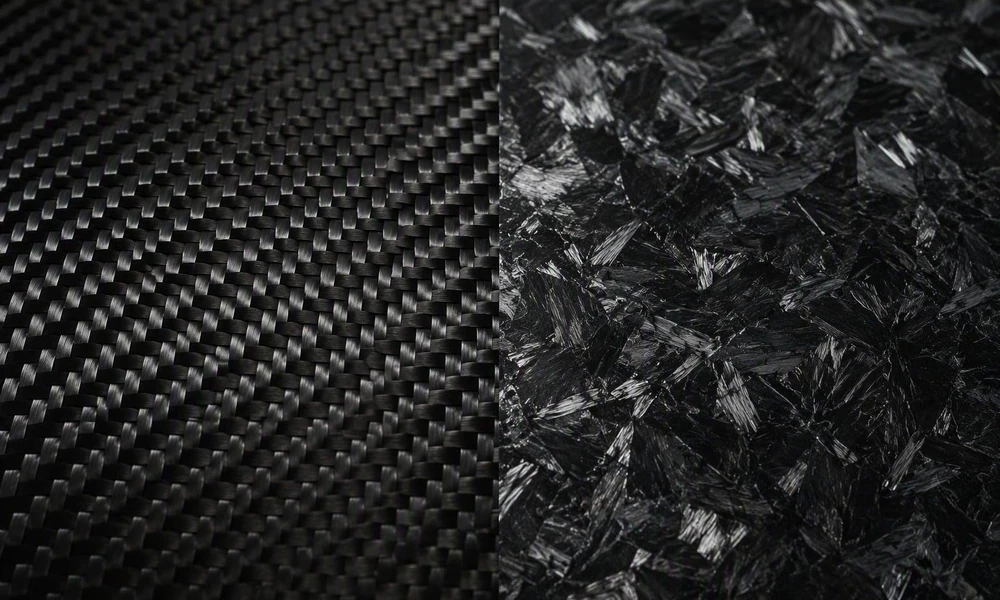
Two materials, one name, zero interchangeable answers.
They share a name, a color, and a catalog, but woven and forged carbon fiber are different materials that happen to be cousins. One is cloth turned to stone; the other is marble born in a press. Choosing between them is not about which is better. It is about which one your part, your car, and your eye actually need. Here is the honest comparison.
The Construction Difference in One Paragraph
Woven carbon is continuous fiber fabric, thousands of unbroken filaments crossing in a weave, laid into a mold and set in resin. Forged carbon is chopped fiber, 10 to 50 millimeter strands mixed with resin and compression-molded under pressure. The woven part gets its properties from the weave’s orientation. The forged part gets its properties from randomness. That single difference drives everything else on this page. The forged vs woven carbon comparison has the full property breakdown.
Strength: Directional Excellence vs Multi-Directional Adequacy
Along its fibers, woven carbon is one of the strongest materials humans make. Across them, it is merely good, which is why serious woven parts stack plies at engineered angles. Forged carbon spreads moderate strength in every direction at once. No weak axis, but no peak either. Translation: a wing taking loads in known directions wants weave. A bracket or complex fitting taking loads from everywhere wants forged. Directional excellence versus multi-directional adequacy. Pick the one your load case actually is.
Shape: Cloth vs Paste
Woven fabric drapes, and draping has limits: deep curves, sharp draws, and intricate three-dimensional shapes fight the fabric every millimeter. Forged compound flows, filling molds of almost any complexity. This is why large flat or gently curved panels, hoods, roofs, wings, are woven territory, while complex shapes, engine covers, intake components, structural fittings, are where forged earns its keep. The material follows the geometry, not the trend.
The Look: Shimmer vs Marble
Woven carbon’s 2×2 twill shimmer is the classic. Thirty years of racing heritage in a surface. Forged carbon’s marble pattern is the modernist alternative: chaotic, technical, and unique to every single part, since the random fiber settling can never repeat. Which reads better is pure taste, but consider the context: weave suits heritage and track builds, forged suits modern and design-led builds. The carbon fiber color guide covers how each pattern interacts with finishes and car colors.
The Misconceptions Worth Killing
Two myths follow forged carbon everywhere. First: that it is fake or lesser carbon. It is the same fiber, the same resin family, the same curing chemistry. Only the fiber length and molding method differ, and the process is arguably more industrialized, not less. Second: that it is always weaker. In peak directional strength, yes, weave wins. But a forged part designed for its strength profile, thicker sections, molded-in ribs, shapes woven layup cannot produce, often outperforms a woven part forced into geometry it hates. Construction fitness beats construction pedigree.
The Repair and Care Difference
Living with forged carbon is mostly familiar: the same UV-and-clear-coat rules as any composite apply, and the same wash-and-inspect habits serve it well. Repair is where it differs. A damaged woven part shows its injury in the weave pattern; a forged part’s random pattern hides small repairs gracefully, and composite shops can rebuild damaged zones without matching any pattern at all. The marble forgives. For parts that live in harm’s way, that forgiveness is a quiet but real advantage.
Cost and Availability
Forged carbon’s compression molding runs fast, minutes per part, which should make it cheap, and someday will. Today, tooling costs and lower production volumes keep prices comparable to quality woven parts, sometimes higher for complex pieces. Woven carbon has the deeper aftermarket: more parts, more sellers, more price tiers. If availability matters, you want the part this month, for your specific car, woven usually wins on selection alone.
The Decision Matrix
One practical shopping note first: forged parts are mold-dependent, so availability follows tooling. Popular platforms get forged options early; rare chassis may wait. If the part you want does not exist in forged yet, that is not a verdict on the material. It is a verdict on the mold economics, and those change with demand.
- Large panels, hoods, wings: woven. Classic look, peak directional strength, deep aftermarket.
- Complex shapes, brackets, engine covers: forged. Geometry wins arguments.
- Track and load-critical parts: woven, with engineered ply orientation.
- Design-led builds and modern supercar aesthetics: forged, uniqueness included.
- When in doubt: match what the car already wears. Coherence beats either choice made randomly.
The happy ending is that this is not a rivalry. The best modern builds use both. Woven where loads and tradition live, forged where shapes and novelty call. Two dialects of the same language, finally easy to tell apart. Choose by the load case and the look, and either material will serve you well.